
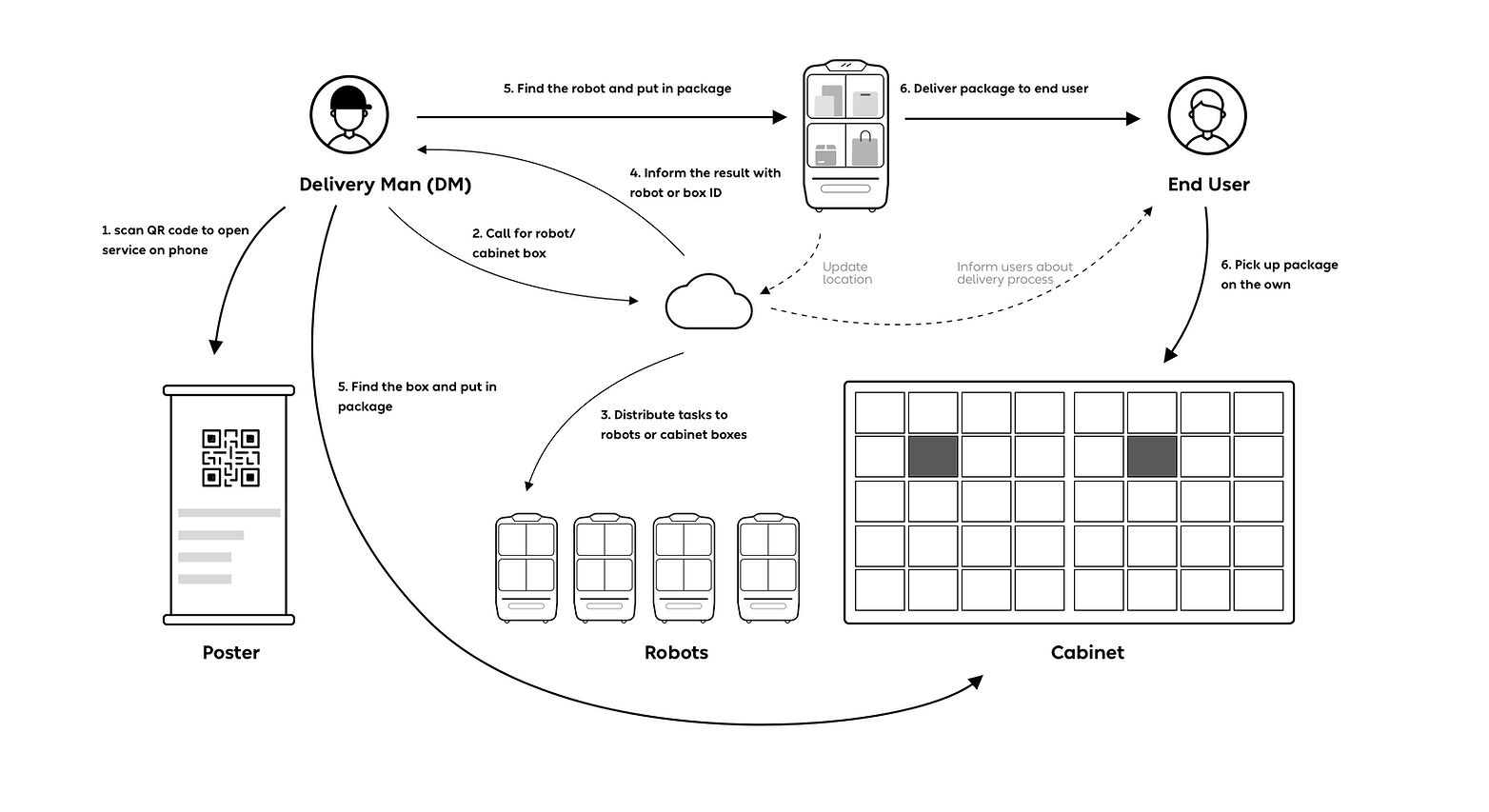
In-building Delivery was one of YOGO's main business. YOGO provided hardwares and softwares to building owners, that delivery men(DM) could call robot to deliver food up floor. Which saved time for both delivery men and users. The system contained robots, intelligent storage cabinet, Wechat applet for delivery men and users.
In this project, I worked as a product manager as well as UX designer, aiming to improve efficiency and accessibility of put-in experience and release anxiety of delivery men.
Service Overview
The system contains several touch points and connects delivery men out of building and end users inside building. Each building has 2-15 robots and several smart boxes, depending on building's height.
When a delivery men enters a building, he scans a QR code and opened Wechat applet to call robot or cabinet Then the robot would take lift and deliver packages to users.
This project mainly improved the experience of delivery men's side.
"I'M GETTING LATE, SHIT!"
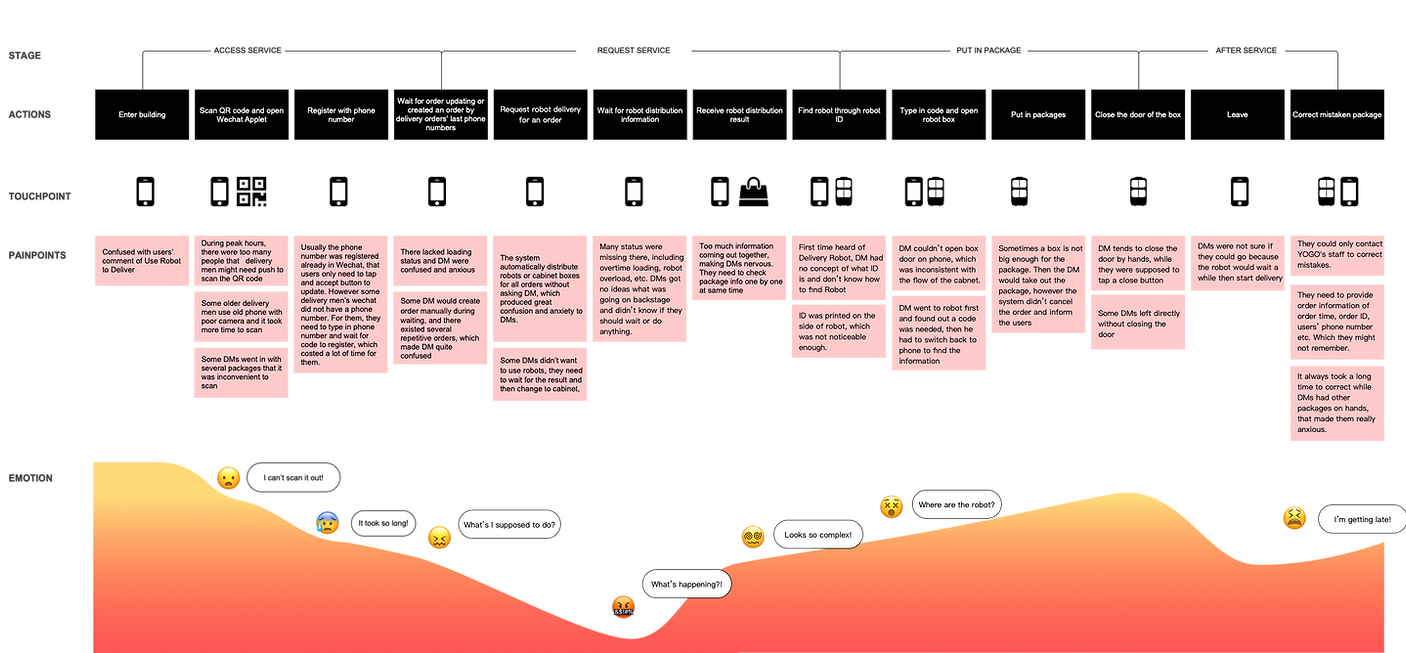
Being anxious of losing control was the main emotion we observed on site.
Imagine a middle-aged junior graduated man who had no interest in technique. He needs to use Robot who speaks nothing to deliver successfully within 5 minutes during busy lunch hours, if failed, he might lose the money he earned for one day.
In this case, any inconsiderate design would cause great trouble for them.
We mapped out the user journey and pain points on using robot delivery service.
Design Audit
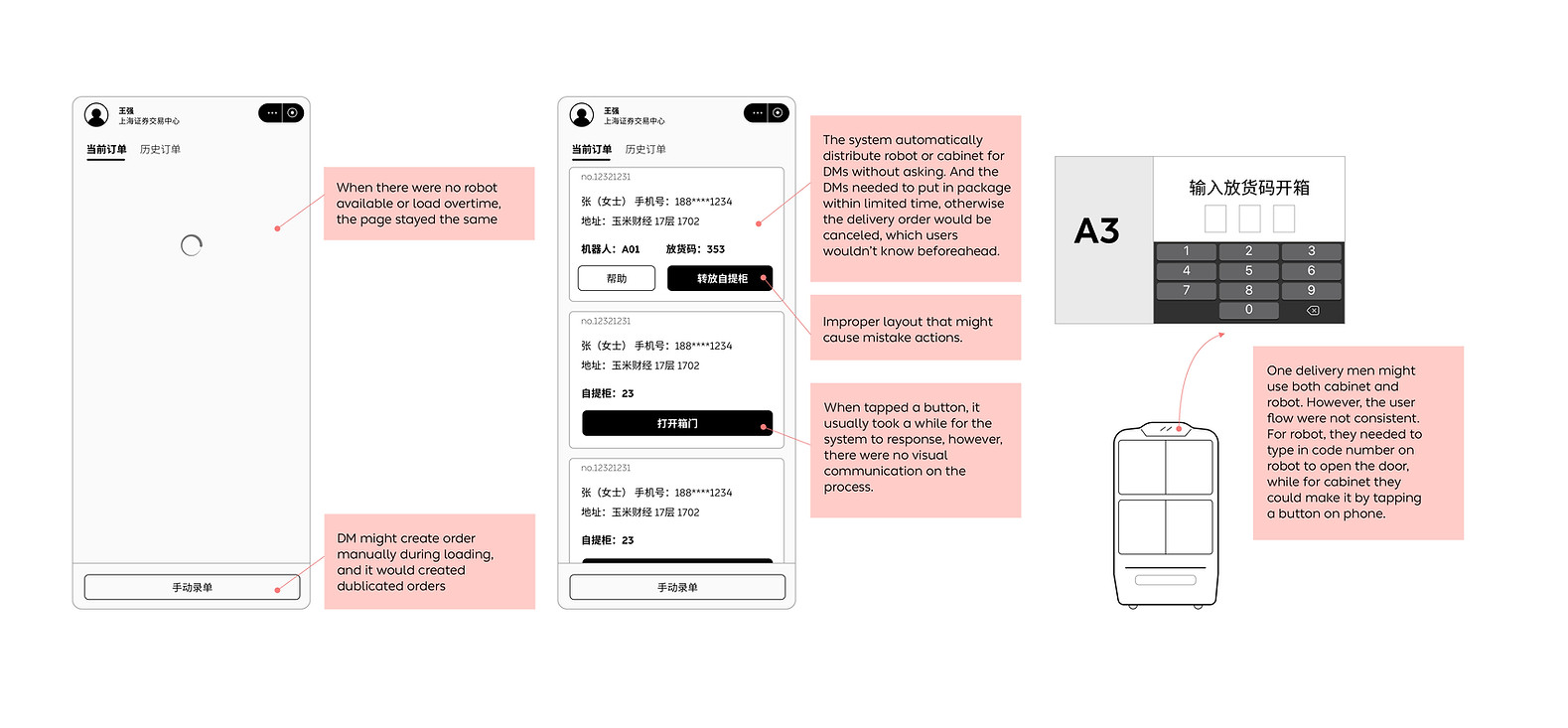
We analyzed previous design and concluded main issues that created obstacles for end users.
Lacking Communication
1) The system automatically distribute robot or cabinet for DMs without asking. And the DMs needed to put in package within limited time, which raised great anxiety for them.
2) When tapped a button, it usually took a while for the system to response, however, there were no visual communication on the process.
Broken User Flow
1) When the system got stuck, it kept on loading and gave no alternative options to users.
2) DM couldn't recall a mistaken package without help of staff.
3) Missing feedback on failure cases, including location unavailable, robot breakdown, elevator unavailable, etc.
Unintuitive Interaction
1) For robot, DM needed to type in code number on robot to open the door, while for cabinet they made it by tapping a button on phone.
Persona
According to our data, over 70% of the delivery men were new to a building, which means the service faced lots of new users per day.
For this group, there were two main personas, one was more open to new techniques, that they learn things quick. Another one was more passive on new techniques. As the latter one faced more problems and took a mojority of the group, we chose them as the target persona.
Wang Qiang
“I hope I could earn as much as I could for my child. Quick and right are the only thing I care.“
Age:46
Education:Junior School
Device:HUAWEI (used for 3 years)
Experience:1 year delivery experience
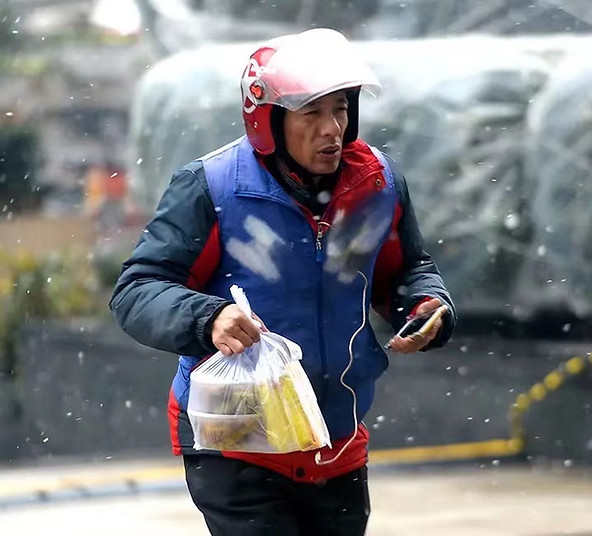
Wang Qiang came from Anhui Province, he used to run a fruit store. He came to Shanghai last year with a fellow villager because he wanted to earn more money for his son, who was his pride and studied at university.
The most busy time was from 11:00 to 13:00, when he had to rush to be on time. If he failed, he might receive users complaints and lose money.
He liked those buildings which had a shelf that he just needed to put package down and leave. He held a passive altitude towards techniques that he would learn to use only when he had to.
Goals & Solutions
Quick & Confident was the goal for new design.
We approached mainly through the following solutions.
Clear Communication
1)The system tried to detect and fix failure before ahead. For those couldn't be avoided, DM would know the reason and action
2)We showed in-process status and use visual hints to create better experience
3)DMs made the first step to decide which service to use
Simplified Mental Model
1) We aligned the mental model of using robot and cabinet to one. It contained 5 steps: select robot/cabinet, open door, put in, close door, leave
2) DMs could use Ring button to help find robots
Give alternative options
1) DM could call back robot to correct mistaken packages
2) They could also cancel or change service type
3) DM could close door by hands or through phone or robot screen
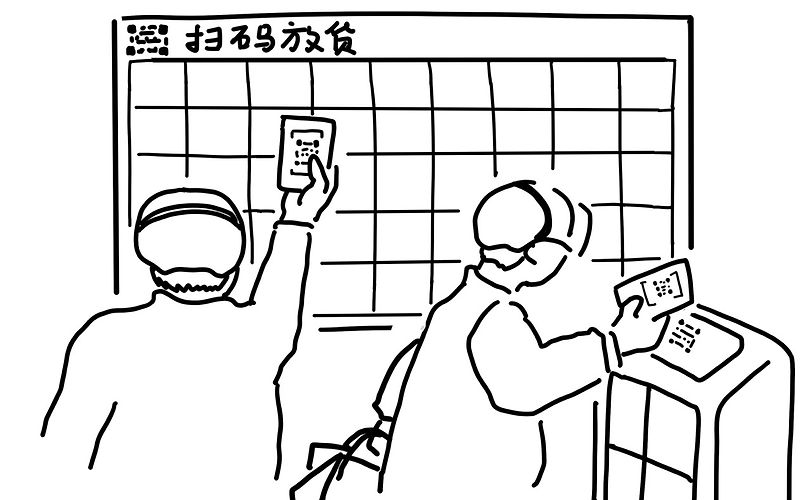
We put QR code high above the cabinet or on robots to create smoother moving flow.
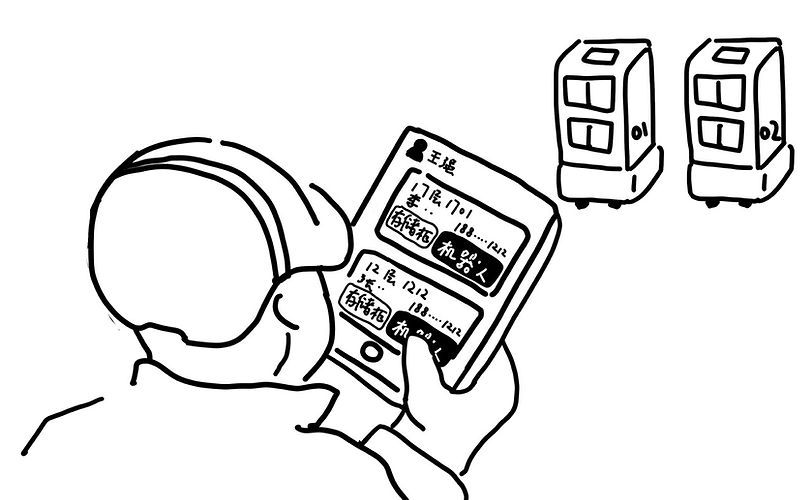
It would automatically download orders on delivery platform. DM could choose to order a robot or cabinet box.
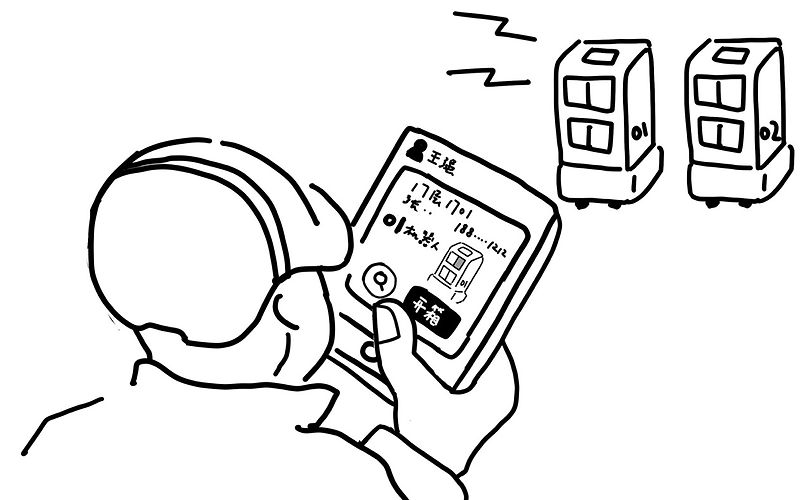
Tap Ring button on phone to find robot with sound feedback.
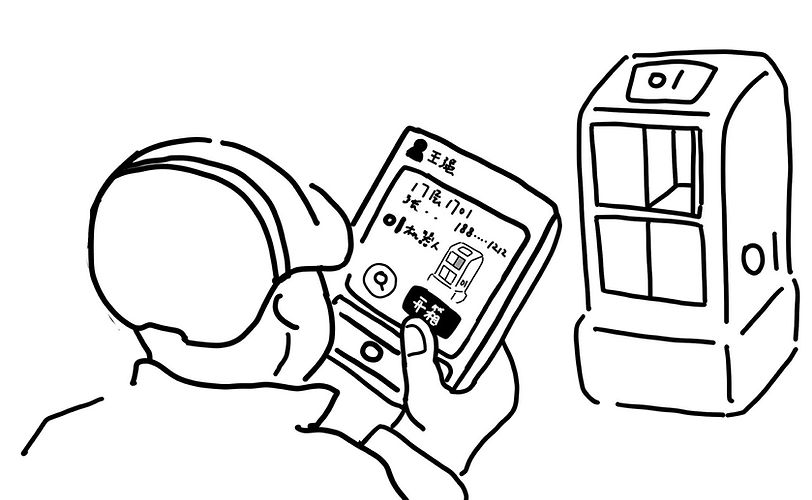
Close to the robot, DM could tap button on phone to open the door.
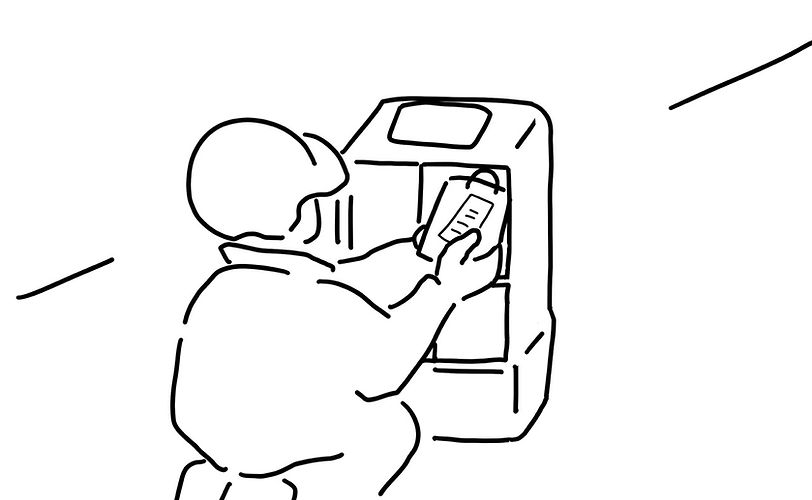
Put in packages and close door with little effort, as the robot would detect the movement and close the door automatically
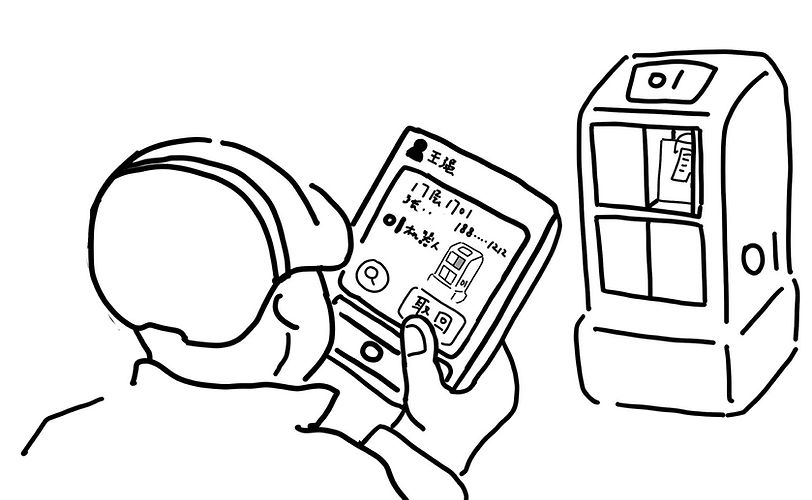
DM could recall mistaken packages by call back the robot and reopen box on phone
Prototype
We made prototypes and tested among our colleagues, after iterations, we run A/B test on some sites and found out that the rate of cancellation was lower if we let DMs to take the first step to call robot. We also went on site to observe and run quick iterations.
Failure Cases
There were many failure cases due to building operation, technique limitations, overload orders, etc. We tried to avoid those cases beforeahead and for the remaining scenarios, we clarified those cases with clearer communication.
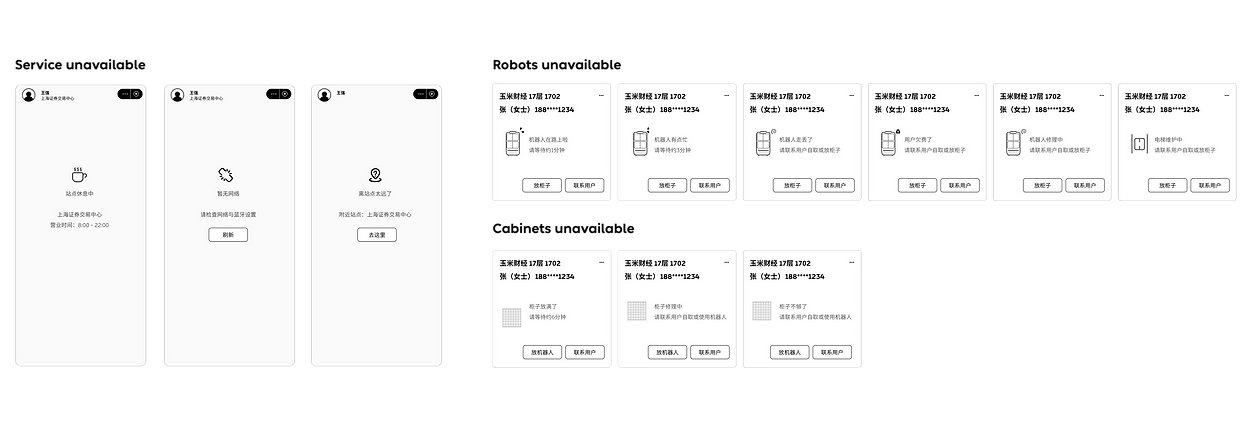
To be better
According to our observation and feedback of on-site staff, the new design was easier for delivery men to learn and covered more corner cases. However, there were still some problems with no perfect solution yet.
Mistaken packages that couldn't be traced
Sometimes users didn't close the door, then a delivery man might put in packages without records in system. For this circumstance, the only solution was call our staff to enter management mode to search possible boxes.
The system might make mistakes as well
The decision on robot arrangement was operated on cloud, which took the whole building resources into consideration, including estimation of elevator and people flow. This would cause some technical delay and vibrates to users, which also had probabilities to cause mistaken packages.
Users' ID were too similar
Delivery men could also create an order manually through typing in the last 4 phone numbers of end users and choose address. Delivery men was very likely to make mistakes during this process.
During this project, I understood that a system with different terminals were quite complex that it needed even a bigger system to support it, and some solutions are technical level, which was totally beyond my knowledge. The only direction is cooperation rather than thinking alone.